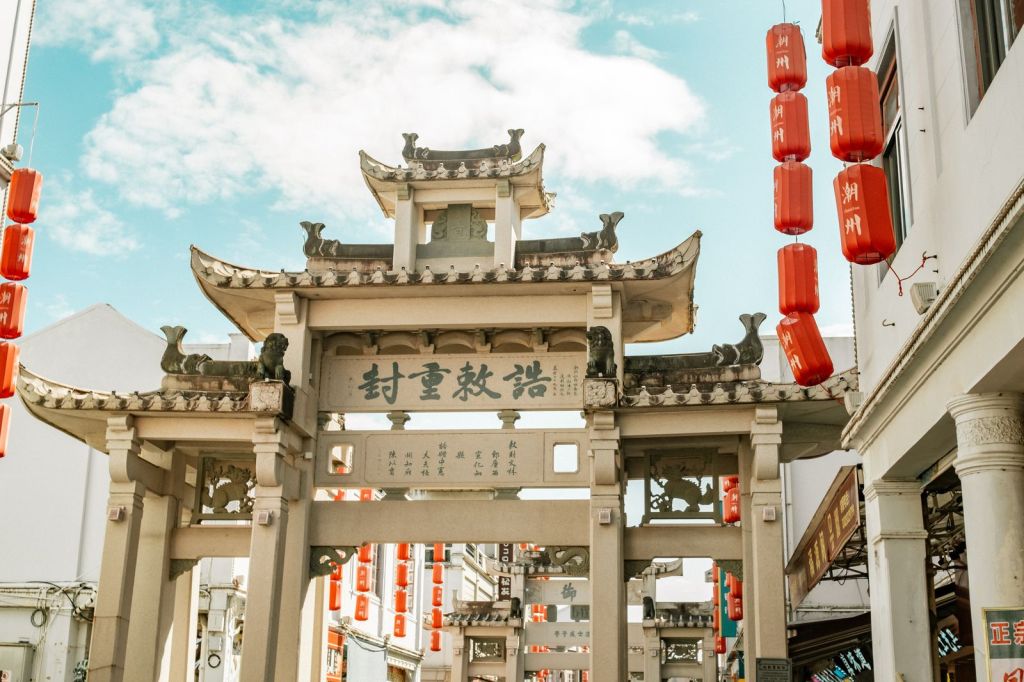
Chaoshan Min, better known in English as Teochew (潮州話, Tiô-tsiu-uē) and also called Chaozhou, Swatow or Teo-Swa, is a Southern Min language of the Sinitic branch of the Sino-Tibetan family. It is spoken in the Chaoshan region of eastern Guangdong province in China, which covers the cities of Chaozhou, Shantou and Jieyang. About 14 million people spoke it there in 2004, and several million more speak it overseas.
Chaoshan was one of the main sources of Chinese emigration to Southeast Asia from the 18th to the 20th century. Teochew speakers form the largest Chinese group in Thailand, Cambodia and Laos, and there are large communities in Vietnam, Singapore, Malaysia and Indonesia, as well as in France, the United States, Canada and Australia. Teochew is closely related to Hokkien, but the two are only partly mutually intelligible, and it cannot be understood by speakers of Mandarin or Cantonese. It is considered one of the most conservative Chinese languages, keeping pronunciations and vocabulary from Old Chinese that most other varieties have lost.
Although Teochew still has millions of speakers, it is losing ground among the young. In China, Mandarin is the language of schooling and public life, and many younger speakers have only basic conversational ability and no longer know the idioms and formal vocabulary of their elders. In Singapore, government policy promoting English and Mandarin has led younger Teochews to shift away from the language, and in Hong Kong most descendants of Teochew migrants now speak Cantonese. Teochew has no standard written form, so most speakers cannot read or write their own language.
Speakers in China and across the diaspora are working to keep the language alive through online dictionaries, video lessons, language competitions, and films and children’s books in Teochew.

