
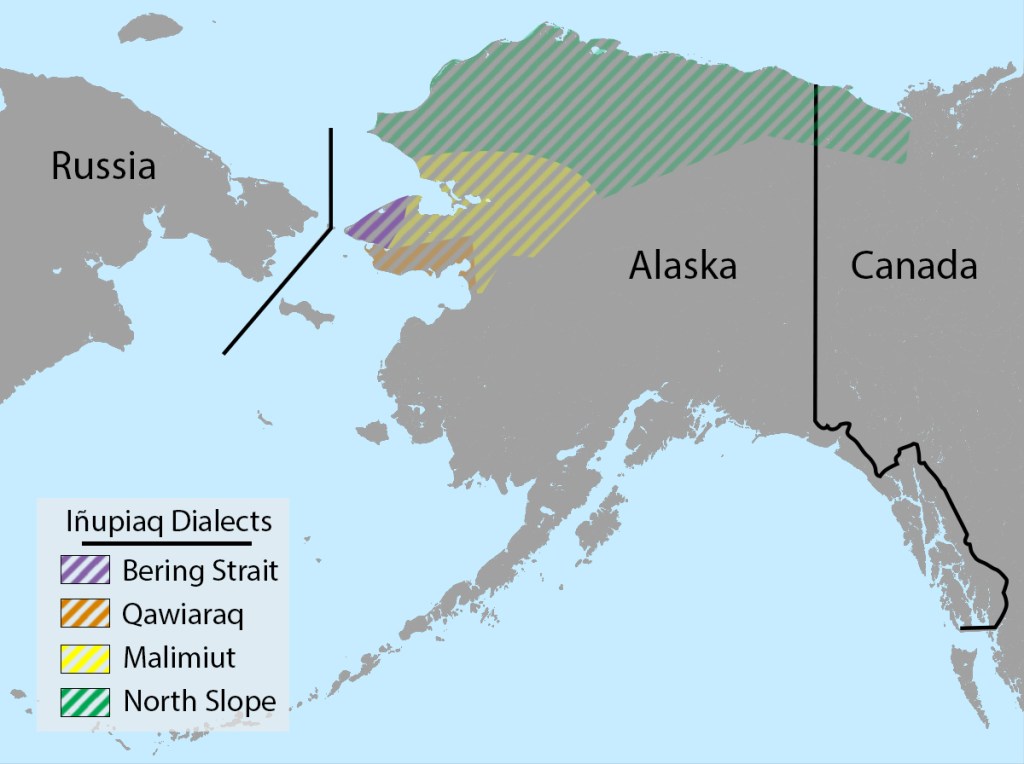
Iñupiaq is an Eskimo-Aleut language spoken in northern and northwestern Alaska in the USA. In 2010 there were about 2,000 speakers of Iñupiaq, who are known as Inupiat. The language is also known as Inupiatun, Inupiaq, Inyupiaq, Inyupiat, Inyupeat, Inyupik or Inupik.
There are two main clusters of Iñupiaq dialects: Seward Peninsula Inupiatun, and Northern Alaskan Iñupiatun. The former includes Bering Strait, and Qawiaraq dialects, and the latter includes Malimiutun, and North Slope dialects.
There are also some speakers of Iñupiaq in Inuvik and Aklavik in the Northwest Territories of Canada. They speak a Northern Alaskan dialect of Iñupiaq known as Canadian Iñupiaq or Uummarmiutun. Their ancesters migrated to Canada from Alaska in the 1910s.
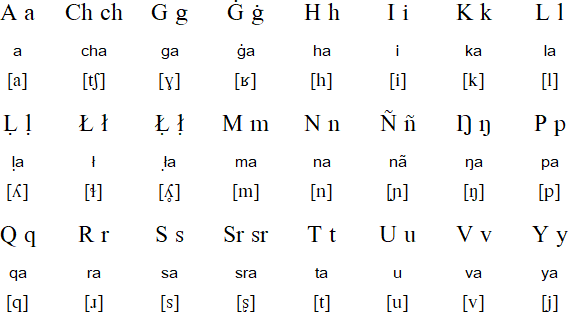
Iñupiaq was first written by explorers in Alaska who devised various ways to write the language, none of which were very consistent. A spelling system developed by Moravian missionaries in Greenland and Labrador was eventually adopted for Iñupiaq.
The current system was developed by Roy Ahmaogak, an Iñupiaq Presbyterian minister from Barrow, and Eugene Nida, a member of the Summer Institute of Linguistics, in 1946.
A numeral system for Iñupiaq, called Kaktovik (Iñupiaq) numerals, was created in the 1990s by students at a school in Kaktovik, Alaska.
 Endangered Voices Initiative